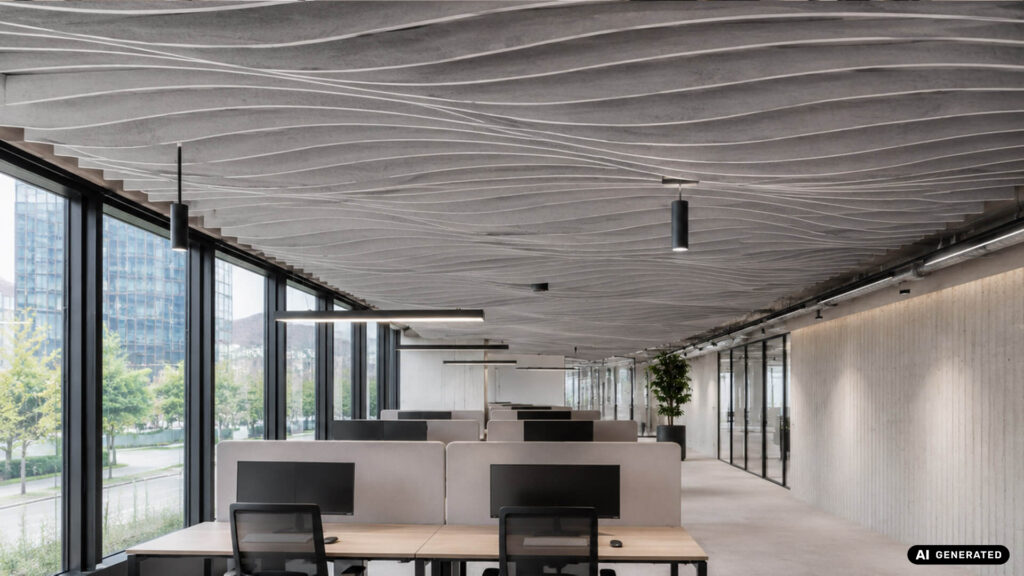
When rooms echo, conversations become tiring, and every sound travels across the space, the problem often lies not in the volume itself, but in the room acoustics. This is precisely where ceiling baffles come into play: suspended from the ceiling, they help absorb sound, reduce reverberation, and make rooms acoustically more pleasant.
Ceiling baffles can offer a solution that is both functional and aesthetic, particularly in offices, schools, restaurants, foyers, exhibition spaces, or large commercial areas.
What are ceiling baffles?
Ceiling baffles are acoustic elements suspended vertically or at a slight angle and mounted to the ceiling. Unlike conventional flat ceiling panels, they typically hang freely in the space and are positioned perpendicular to the ceiling surface.
The major advantage: This positioning allows sound to be absorbed not just on one side, but across multiple surfaces of the element. Acoustic baffles are therefore frequently used in areas with large ceiling surfaces or where wall surfaces cannot be utilized.
- Acoustic felt
- Mineral fiber or glass wool cores with fabric covering
- PET felt
- Wooden slats with an acoustically effective structure
- Textile or printable acoustic elements
The important thing is: a ceiling baffle is not merely decorative. It must be made of a material that can actually absorb sound.
What purpose do ceiling baffles serve?
The primary purpose of ceiling baffles is to improve room acoustics. Many modern interiors feature hard surfaces—such as concrete, glass, metal, smooth floors, large window fronts, or exposed ceiling structures—that strongly reflect sound.
- Voices sound louder and less distinct.
- Conversations overlap.
- Rooms feel restless.
- Concentration is becoming more difficult.
- speech intelligibility suffers
Ceiling baffles mitigate these problems by absorbing sound energy, thereby reducing the reverberation time. A reduced reverberation time ensures that speech is understood more clearly and that sounds do not linger in the room for as long. The DIN 18041 standard specifically addresses acoustic quality in rooms and sets out requirements and recommendations for room acoustics across various usage scenarios.
Where are ceiling baffles used?
Ceiling baffles are particularly suitable for rooms where there is a lot of talking, working, or communication. Typical locations:
Offices and open-plan offices
In open-plan offices, multiple simultaneous noise sources arise: phone calls, keyboards, conversations, and meetings. Ceiling baffles can help make the overall noise level feel more pleasant and reduce the acoustic burden.
Schools, seminar rooms, and universities
Good acoustics are crucial wherever speech needs to be understood. Short reverberation times aid intelligibility and can significantly improve classroom or lecture settings.
Restaurants and cafés
Many hospitality spaces feature hard floors, exposed ceilings, and large glass surfaces. While this looks modern, it often results in unpleasant reverberation. Ceiling baffles can be used here either unobtrusively or as a deliberate design element.
Foyers, reception areas, and exhibitions
Large, open spaces can easily sound reverberant. Ceiling baffles can help acoustically calm such areas without obstructing walls or exhibit spaces.
Industrial and commercial sites
Suspended acoustic elements can also be a sensible choice in production, workshop, or warehouse environments where structural conditions make conventional wall or ceiling solutions difficult to implement.
Why specifically on the ceiling?
The ceiling is often one of the largest unobstructed surfaces in a room. Meanwhile, wall areas are frequently reserved for doors, windows, shelving, technical equipment, branding, or displays. Ceiling baffles thus utilize a surface that often still holds untapped potential in terms of both design and functionality.
Another advantage: Baffles hang freely in the space, allowing them to absorb sound from both sides. This makes them particularly attractive for large rooms, high ceilings, or open ceiling structures.
Ceiling baffles vs. ceiling rafts: What is the difference?
Both solutions improve room acoustics, but function somewhat differently in terms of their construction.
Ceiling rafts are typically flat acoustic elements suspended horizontally beneath the ceiling. They act as a second, acoustically effective layer.
In contrast, ceiling baffles usually hang vertically or at an angle within the space. This creates a stronger spatial structure, and the elements can absorb sound on both sides.
- Ceiling rafts: horizontal, calm, planar
- Ceiling baffles: vertical, rhythmic, spatial
- both solutions: effective against reverberation
- The choice depends on room height, design, technology, acoustic objectives, and installation conditions.
In some projects, a combination may also be appropriate: ceiling treatments reduce the overall reverberation time, while additional wall absorbers can specifically influence reflections and sound propagation at ear level.
How can ceiling baffles be implemented?
Implementation does not begin with installation, but with the question: Which acoustic problem needs to be solved?
1. Analyze the space and its use
- How big is the room?
- How high is the ceiling?
- What surfaces are present?
- Is there talking, working, eating, or presenting taking place in the room?
- Are there many hard materials?
- Where do most noises originate?
- Where do most noises originate?
Without this analysis, there is a risk that too few, incorrectly positioned, or unsuitable elements will be planned.
2. Define acoustic target
Not every room requires the same acoustics. A restaurant should sound lively, but not unpleasantly loud. A meeting room requires good speech intelligibility. An open-plan office needs acoustic calming without making the space feel dead.
- Reduce reverberation
- Improve speech intelligibility
- Make the noise level more pleasant
- acoustically zone open areas
- facilitate focused work
3. Select material and format
Ceiling baffles are available in various shapes, sizes, colors, and materials. The selection should not be based solely on appearance.
- acoustic effectiveness
- Fire protection requirements
- Weight
- Mounting type
- Cleanability
- Design
- possible printing or color design
- Compatibility with lighting, ventilation, and sprinkler systems
Fire safety and technical requirements should be assessed at an early stage, particularly in public, commercial, or high-traffic areas.
4. Plan positioning
Ceiling baffles are frequently arranged in rows, grids, or groups. Their positioning influences not only the acoustics but also the sense of space.
- parallel rows above workstations
- rhythmic arrangement in corridors or reception areas
- Colored acoustic surfaces matching the corporate design
- subtle tone-on-tone solution
- localized acoustic zones above seating areas
- Combination with luminaires or technical ceiling elements
Important: The elements must not obstruct critical technical systems. These include, for example, lighting, ventilation, smoke detectors, sprinklers, access panels, or ceiling installations.
5. Clarify fastening and installation
Depending on the system, installation is carried out using wire cables, rails, pendant suspensions, or special mounts. It is crucial that the ceiling structure is load-bearing and that the mounting is carefully planned.
- Ceiling material
- Load capacity
- Suspension height
- Fire protection
- Escape and rescue routes
- technical installations
- Cleaning and maintenance access
For commercial projects, installation should not be improvised. Professional planning prevents future issues regarding safety, aesthetics, and functionality.
Can ceiling baffles also be designed or printed?
Yes, depending on the material and system, ceiling baffles can also be used for design purposes. They do not have to look like purely technical acoustic elements.
- colored acoustic felts
- Custom-cut shapes
- printed textile surfaces
- Corporate identity colors
- graphic patterns
- Zoning through color and arrangement
- Combination with branding elements
Particularly in offices, showrooms, reception areas, or exhibitions, this allows the acoustic solution to become part of the spatial concept.
The crucial point: The design must not impair acoustic performance. Therefore, the material, printing process, and construction should be suited to the acoustic application.
When are ceiling baffles particularly useful?
- the room is very reverberant
- the ceiling is high or open
- Wall surfaces are not available
- large glass or concrete surfaces are present
- a visible design solution is desired
- the room is to have its acoustics improved retrospectively
- the acoustics are to be improved without significantly altering the architecture
They are less suitable where ceilings are very low or where ceiling-mounted technical equipment leaves no room for suspended installations. In such cases, ceiling rafts, wall absorbers, or other acoustic solutions may be more appropriate.
Conclusion
Ceiling baffles are an effective solution for making reverberant rooms acoustically more pleasant. They reduce reverberation, improve speech intelligibility, and can simultaneously serve as a design element.
Particularly in offices, schools, restaurants, foyers, exhibition spaces, and commercial interiors, they offer a flexible way to combine acoustics with interior design. Careful planning is crucial: the space, intended use, materials, fire safety, installation, and design must all be considered in conjunction.
In short: Ceiling baffles are not merely ceiling decorations. When properly planned, they make rooms quieter, improve speech intelligibility, and make them significantly more pleasant to use.
FAQ: Frequently Asked Questions About Ceiling Baffles
What are ceiling baffles?
Ceiling baffles are suspended acoustic elements that hang from the ceiling, usually vertically or at a slight angle. They absorb sound and help reduce reverberation in the room.
What are ceiling baffles used for?
They are used to improve room acoustics. Especially in reverberant spaces, they ensure better speech intelligibility, fewer distracting reflections, and a more pleasant sound environment.
Where do ceiling baffles make sense?
They are useful in offices, schools, restaurants, reception areas, exhibition spaces, conference rooms, foyers, and larger commercial areas. They are particularly helpful in rooms with hard surfaces and high ceilings.
What is the difference between ceiling baffles and ceiling rafts?
Ceiling rafts usually hang horizontally beneath the ceiling, whereas ceiling baffles typically hang vertically or at an angle. Both reduce reverberation but differ in terms of appearance, installation, and spatial impact.
Do ceiling baffles really improve acoustics?
Yes, provided they are professionally designed and made from suitable, acoustically effective materials. They absorb sound energy and can thereby reduce the reverberation time in the room.
Can ceiling baffles be printed?
Printing is possible, depending on the material and system.
What material are ceiling baffles made of?
Commonly used materials include acoustic felt, PET felt, fabric-covered mineral fiber cores, textile acoustic elements, and other sound-absorbing materials. The specific choice of material depends on acoustic objectives, fire safety requirements, aesthetics, and installation methods.
How are ceiling baffles installed?
They are typically attached to the ceiling using wire ropes, rails, pendulum suspensions, or special mounts. The ceiling must be suitable and capable of supporting the load.
Does an acoustic plan need to be prepared before installation?
For professional projects, planning is highly advisable. Room size, usage, surface finishes, ceiling height, and the desired reverberation time influence how many elements are required and where they should be positioned.
Are ceiling baffles also suitable for rooms with low ceilings?
Only to a limited extent. With low ceilings, suspended elements can quickly become intrusive or reduce the room height. In such cases, shallower ceiling rafts or wall absorbers are often the better solution.
Can ceiling baffles be installed retroactively?
Yes, ceiling baffles are well-suited for retrofitting to improve room acoustics. It is important to inspect the ceiling, mounting points, and technical installations beforehand.
What should you look out for with ceiling baffles?
Key factors include acoustic performance, fire safety (where applicable), weight, mounting, suspension height, design, cleanability, and coordination with lighting, ventilation, sprinklers, and other ceiling installations.
Disclaimer: Cover image AI-generated