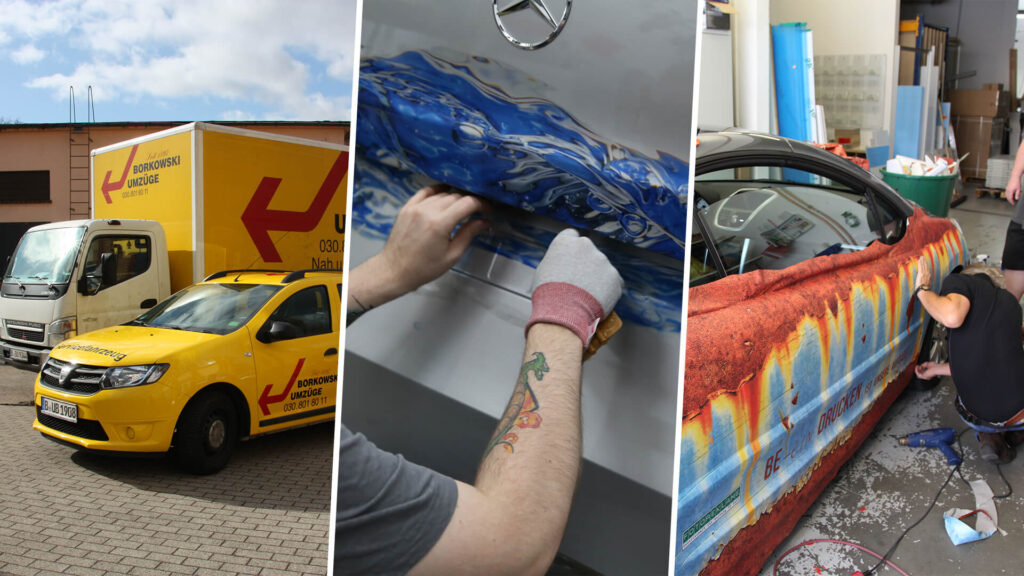
Your company vehicle is on the road every day. But can outsiders tell at a glance which company is behind it and what it offers? Well-designed vehicle graphics transform a means of transport into a visible part of your brand identity—whether en route to a job, parked at your premises, or on-site at a customer's location.
In order for vehicle advertising to work in everyday life, the design, film material and processing must fit together. If there are several vehicles, uniform colors, comprehensible positioning and sensible scheduling are added. This guide will help you Planning vehicle graphics and fleet advertising for your company. The linked sub-articles explore the individual decisions in greater depth – from the appropriate technology to eventual decommissioning.
1. Which vehicle graphics suit your company?
It starts with the question of what message you want people to take away from your vehicle. For a service business, the company name, core service, and clearly legible contact details might take center stage. A company with a highly visual brand identity, on the other hand, may require larger areas for imagery. First, determine the most important message. and arrange further information underneath.
Therefore, evaluate the design from a distance as well. Are the company name and services immediately recognizable? Does the lettering stand out sufficiently against the background? Do key details remain legible when a door is open? The side panels and rear should each work effectively as standalone views. A comprehensive list of services can be communicated in greater detail on the website.
When it comes to technical implementation, it is worth making a clear distinction: Folienplot und Latexdruck beschreiben die Herstellung der Beschriftung. Teilfolierung und Vollfolierung beschreiben den Umfang der beklebten Fläche. These options can be combined with each other.
- Vinyl cut: Letters, logos, and shapes are cut from colored vinyl. This is particularly suitable for crisp lettering and solid design elements.
- Latexdruck: The design is printed onto a suitable film. This allows for the reproduction of photographs, color gradients, and complex graphics. Depending on the application, the printing system may include a matching protective laminate.
- Combination: For example, a printed image area can be supplemented with separately applied contact details. This facilitates subsequent changes to this information, provided the layout was planned accordingly.
Partial wrapping incorporates the vehicle's existing color into the design and utilizes specific surface areas. Full wrapping enables a largely seamless brand presentation across the vehicle's exterior bodywork. The most suitable option depends on the amount of surface area required for the design, the vehicle's base color, and the level of effort appropriate for the intended use. Even with a full wrap, it is important to clearly specify exactly which body parts are included.
2. What influences the cost of vehicle graphics?
The price depends on both the surface area to be covered and the effort involved in completing the vehicle wrap. Simple lettering on a flat door presents different requirements than a large-scale design applied to complex, contoured body panels. Consequently, a price per square meter alone is rarely sufficient for a meaningful comparison of different quotes.
Key price factors include:
- Vehicle and areas: Model, structure, number of sides to be labeled, as well as curvatures, recesses, and attached parts.
- Design and printdata existing production files, necessary adjustments, number of individual elements, and preparation effort.
- Material and production: suitable film, printing process, and, if applicable, protective laminate.
- Preparation and assembly: Cleaning the bonding surfaces, removing old advertising, and application to the vehicle.
- Organization: Number of vehicles, different models, delivery, and available installation times.
To ensure a solid inquiry, you should have the vehicle model, year of manufacture, body style, and current photos ready. Include details on the desired views, existing design files, the planned duration of use, and the timeframe. For a van, factors such as wheelbase, roof height, and sliding door position can be relevant to the planning process.
Compare quotes based on the same scope of services: Are data preparation, removal of old film, surface preparation, and installation included? What materials are specified? Also, consider the length of time the vehicle will be out of service during the work. For a fleet, a phased implementation that aligns with your operational workflows is recommended.
3. How does fleet advertising remain consistent across multiple vehicles?
When it comes to fleet branding, the overall impression of the entire vehicle fleet is what counts. A logo might look right on one van but appear too small or be awkwardly positioned on a different type of bodywork. That is why a consistent brand image requires... common design rules and appropriate implementations for the respective vehicle types.
We recommend establishing four points before serial production:
- Colors: binding color references and approved material or print samples. The on-screen view alone should not serve as the basis for color approval.
- Logo and typeface: Correct files, fixed proportions, defined spacings, and a clear size hierarchy.
- Positioning: Reference points specific to each vehicle model—such as door edges or body lines—allow additional vehicles to be lettered according to the same specifications.
- Production: defined films, surfaces, and print constructions, ensuring that subsequent orders are based on a clear foundation.
A prototype vehicle helps verify these specifications before they are applied to the entire fleet. All relevant perspectives should be considered: Are the logos well-proportioned? Do the contrasts work against the actual vehicle color? Is the spacing relative to handles, panel gaps, and other components correct?
Approved views, dimensions, and production specifications should remain available for reorders. This facilitates the lettering of new vehicles and the replacement of individual elements. For repeat production runs, it is also advisable to compare the output with the existing lettering, particularly if there is a significant time gap between orders. A new print file alone does not guarantee reliable color matching.
4. What distinguishes vans, trucks, and trailers?
Vehicle size reveals only part of the story regarding the graphics application. The material, shape, and usage of the surfaces are equally important. Therefore, the actual configuration—including doors, hatches, fittings, and recesses—should be taken into account during the planning stage.
Transporter signage often feature large side surfaces interrupted by sliding doors, handles, and recesses. Important lines of text should be positioned so that these interruptions interfere with readability as little as possible. The film must be suitable for the specific shape and the intended application method.
For trucks the cab and the bodywork must be assessed separately. Painted body panels, rigid box bodies, and flexible tarpaulins require different solutions. A film designed for a rigid surface is not automatically suitable for a flexible tarpaulin. Even with materials marketed as "banner film," their suitability for the specific truck tarpaulin must be explicitly verified.
Trailer signage can feature rigid or flexible exterior surfaces. For box trailers, design considerations include door configurations, hinges, and locking mechanisms. If the trailer is frequently parked without the towing vehicle, the advertising should remain comprehensible on its own.
Preparation therefore involves not only the vehicle data but also high-quality photos and an inspection of the surface. The installation site must also be suitable for the vehicle's size and the material's application requirements.
5. How do you plan for durability, maintenance, and eventual dismantling?
The intended duration of use should be determined as early as the material selection stage. A short-term campaign imposes different requirements than vehicle graphics designed to remain in place for several years. How long the graphics retain their attractive appearance depends on factors such as the film system, the application process, the orientation of the surface, and the level of wear and tear. A general indication of the year for each vehicle graphic would therefore be too imprecise.
Manufacturers distinguish, for example, between vertical side surfaces and areas more exposed to the sun, such as the roof or hood. Therefore, ask about suitability for your specific application and request appropriate care instructions.
A simple maintenance routine is recommended for everyday use: remove dirt regularly and gently, treat bird droppings or insect residue promptly, and inspect the edges of the film for any irregularities. Guidelines regarding the initial wash after installation, as well as suitable cleaning agents and washing methods, depend on the specifications of the material used. There is also no universal approval for the use of high-pressure cleaners across all film systems.
Removing the lettering is also part of the planning process—for instance, prior to selling a vehicle or rebranding. The effort involved depends on factors such as the type of film, its age, the adhesive used, and the underlying surface. Professional removal takes the condition of both the film and the paintwork into account, and any remaining adhesive residue is treated using appropriate methods.
It is not possible to give a blanket guarantee that all old lettering can be removed without leaving a trace. Areas that have been repainted or where the paintwork is already damaged require special attention. Therefore, discuss any pre-existing damage before applying the graphics and allow time for their eventual removal.
Conclusion: Effective vehicle advertising begins with clear planning.
Die passende Fahrzeugbeschriftung ergibt sich aus Ihrer Werbebotschaft, dem Fahrzeug und der geplanten Nutzung. Für klare Schriftzüge und einfache Logos kommt Folienplot infrage; für Fotos, Verläufe und komplexe Motive eignet sich Latexdruck. Ob ausgewählte Flächen oder eine weitgehende Vollfolierung sinnvoll sind, entscheiden Motiv, Fahrzeugfarbe und Budget.
To ensure a uniform fleet, colors, proportions, materials, and positioning should be strictly defined and applied to the individual vehicle types. Compare offers based on the full scope of services, taking into account installation times, maintenance, and removal. Clarifying vehicle specifications, design requirements, and the intended service life at an early stage creates a reliable foundation for implementation. The in-depth guides help you prepare for the individual decisions.
FAQ: Frequently Asked Questions About Vehicle Graphics and Fleet Advertising
How much does vehicle lettering cost?
Individual lettering entails a different level of effort compared to large-scale printed graphics or a full vehicle wrap. To provide a reliable price quote, at least the vehicle model, the areas to be covered, the design, and material specifications are required. Check the quote to see whether data processing, surface preparation, and installation are included. Additional costs may also apply for the removal of existing graphics.
How long does vehicle lettering last?
Appropriately selected and professionally applied lettering can remain in use for several years. However, any specific statement regarding durability must be based on the specific film system used and the operating conditions. Manufacturer specifications for the intended application serve as a guide; maintenance, exposure to the elements, and the orientation of the surface all influence the outcome.
Can a vehicle with lettering go through the car wash?
This is possible with many vehicle wraps, but the procedure must align with the care instructions for the specific material used. Washing brushes and mechanical stress can affect the surface and the edges of the wrap. Ask about suitable washing methods and the required waiting period after installation. Gentle hand washing is the preferred method for many systems.
Can vehicle graphics be removed without leaving a residue?
Suitable films can be removed under the right conditions. However, adhesive residue may remain and require separate treatment. The age of the film and the condition of the paintwork affect the effort involved. Therefore, "removable" does not automatically mean that any graphic can be peeled off effortlessly and without further work after any length of time.
Can a vehicle wrap damage the paintwork?
Damage can occur, particularly on unsuitable substrates or due to improper application and removal. Problematic factors include, for example, poorly adhering repainted areas, insufficiently cured paint, or pre-existing damage. Wrapping is not a substitute for paint repair. The condition of the surfaces to be wrapped should be inspected beforehand.
Does a vinyl advertising wrap also protect against stone chips?
Standard advertising or colored vinyl films can withstand minor everyday wear and tear, but they are not automatically stone chip protection films. If the primary goal is protecting the paintwork, one should specifically consider paint protection films—often referred to as PPF—designed for this purpose. Advertising design and protective function should be explicitly discussed when selecting the material.
Can I apply vehicle graphics myself?
For small, simple decals applied to flat surfaces, self-installation may be an option depending on the product. Larger designs, recessed areas, and continuous graphics require experience in alignment, surface preparation, and application techniques. To ensure a consistent corporate image and for the branding of multiple vehicles, professional installation in accordance with specific material guidelines is recommended.
Are you planning the branding for a company vehicle or your entire fleet? Fotoreklame is your partner for consultation, production, and installation regarding vehicle graphics and fleet branding.