A decision-making aid for companies and fleets
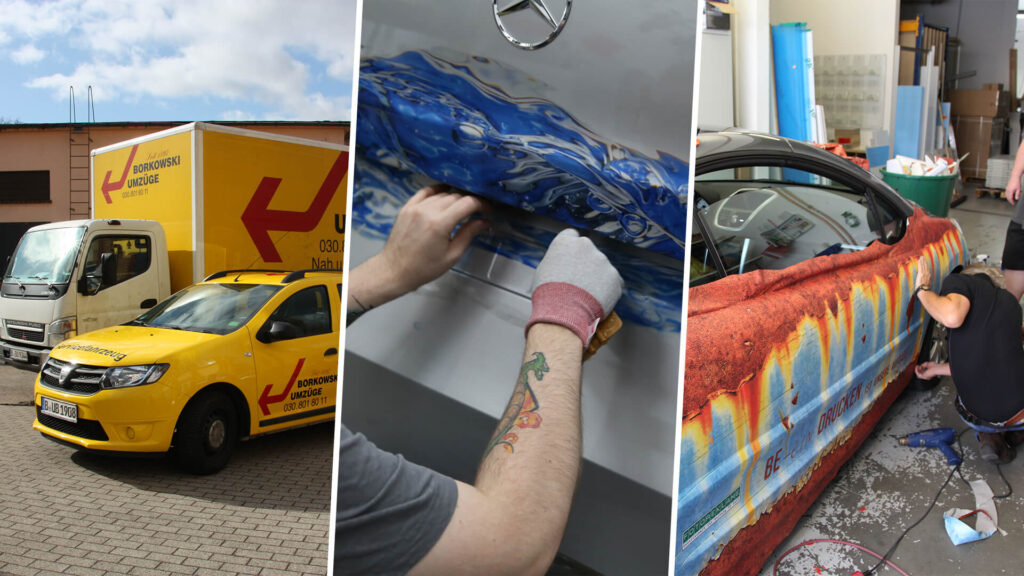
Plotter-cut vinyl is often a suitable option for lettering and simple logos, while digital printing allows for the reproduction of photos and color gradients. Another decision involves the size of the covered area: depending on the vehicle and the design, options ranging from individual lettering to partial or full vehicle wraps may be appropriate.
For companies, the evolution of the advertising design in day-to-day operations is also a key factor. Will the design remain unchanged for several years? Will phone numbers or locations change? Will different vehicle models be added to the fleet? Clarifying these questions prior to production allows for targeted preparation for future changes and enables the evaluation of quotes on a comparable basis.
Correctly Categorizing Vinyl Plotting and Digital Printing
With classic vinyl cutting, letters, logos, or shapes are cut out of colored self-adhesive vinyl. The excess material is removed, leaving only the desired elements on the vehicle. In digital printing, the design is printed onto a suitable film; this, too, can subsequently be contour-cut. Consequently, a printed logo does not require a rectangular background.
Partial wrapping, on the other hand, refers to the extent of the application. It can consist of colored vinyl, printed vinyl, or a combination of both. For a company vehicle, for instance, a printed graphic area can be combined with separately cut contact details.
| Criteria | Vinyl cut from colored film | Digital printing on film |
|---|---|---|
| Motif | Typography, clean shapes, and logos using a limited number of solid colors. | Photos, gradients, and complex multi-colored designs |
| Color selection | Select suitable film colors using samples. | Verify brand colors through coordinated printing and sampling. |
| Workload | Many colors and fine details increase the effort involved in weeding and assembly. | Allow for printing, a protective laminate (if applicable), and cutting. |
| Subsequent amendment | Separately affixed details can be replaced individually. | Printed details require the replacement or revision of the relevant graphic area. |
A limited number of colors makes vinyl plotting a logical starting point. However, production can become complex if there are many small elements or multiple overlapping colors. In such cases, it is worth comparing the option with digital printing—even for a logo. Conversely, a printed color value does not guarantee an exact match with a brand color. Definitive color samples are helpful for both methods.
How much space your design requires
A company name on the doors and clearly legible contact details on the rear can be sufficient for clear identification. If a product image or a larger branding area is also desired, partial wrapping is a good option; this allows the vehicle's existing color to be deliberately incorporated into the design.
A full vehicle wrap should be considered primarily when the original vehicle color is intended to take a back seat to the design or when a consistent visual appearance is desired. This can be particularly relevant for a fleet comprising vehicles of various paint colors. Whether the additional surface coverage and installation effort are worthwhile depends on the design objective.
Therefore, partial wrapping does not automatically offer a price advantage. Under otherwise comparable conditions, covering a smaller surface area can save on material and installation time. However, complex contours, numerous individual elements, or challenging vehicle shapes can reduce this advantage. Have the costs calculated for the specific design options.
Plan for changeable details to be separate from the start.
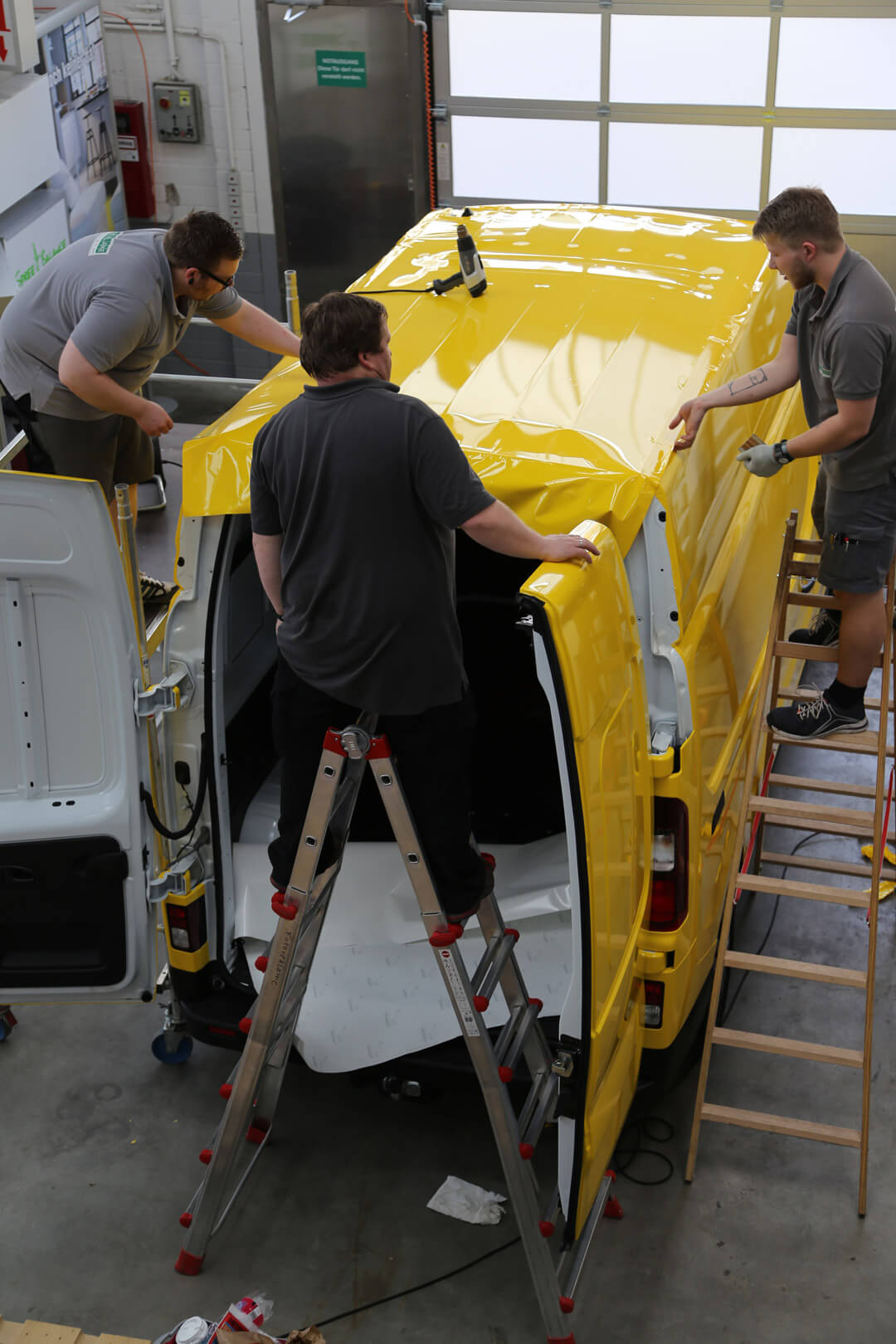
A phone number changes, a location relocates, or a service is discontinued. If this information is permanently integrated into a large printed graphic, it cannot simply be peeled off like an individual letter. Often, the affected graphic panel must be replaced. While applying an overlay may be technically feasible, it requires a solution that is appropriate in terms of both design and materials.
Therefore, a dedicated area is recommended for information likely to require future changes. Contact details, for instance, can be applied as a separate label on the finish. If the background is printed, a clearly defined information panel can be incorporated that allows for replacement as a single unit. This means only the designated area needs to be swapped out, without necessarily requiring the reproduction of the entire design.
Anyone wishing to apply lettering over a film that has already been installed should have the material combination checked beforehand. An additional layer of film cannot automatically be removed independently; the underlying graphic may be damaged during removal. When applied to paintwork, the effort involved and the final result also depend on the material, its age, and the condition of the underlying surface.
Therefore, agree prior to production on which elements are to be interchangeable and how the exchange is to be carried out. This also encompasses the archived production data, the materials used, and the approved colors. Subsequent reprints may exhibit visible differences compared to the existing, aged lettering.
The decision-making process for your vehicle
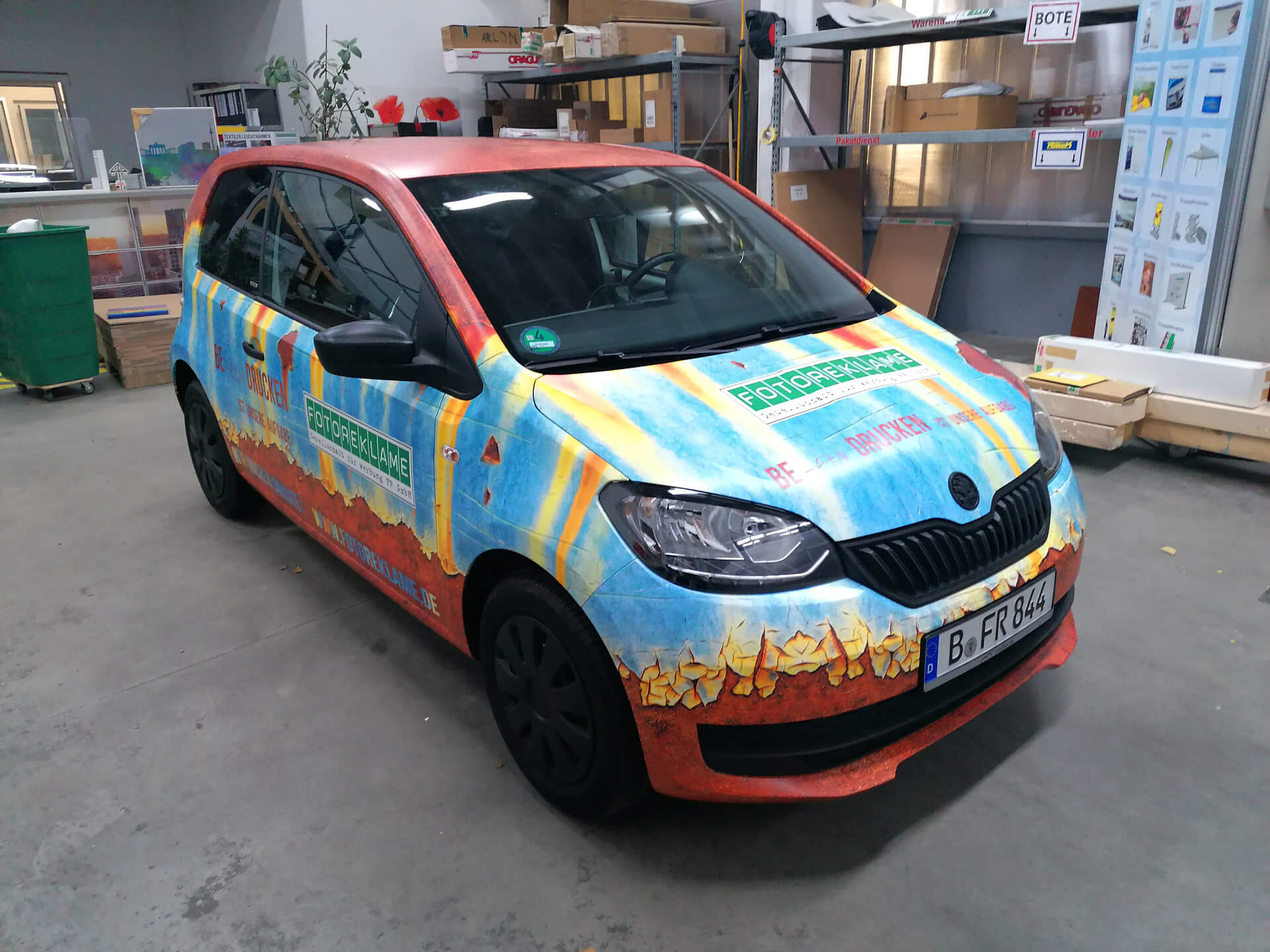
1. Does the design contain photos or color gradients? It may not be possible to render them across multiple individual vehicle components in a way that ensures a perfectly linear flow, since, for example, the wraps for the hood and fenders are printed separately.
2. Should the vehicle color remain part of the design? If so, first consider individual decals or partial wrapping. If these areas are sufficient for the desired design, a concrete draft can be created. If the visible paint color is to be largely replaced, a full wrap is an option.
3. Is any individual information likely to change? If so, designate separate areas for replacement. If not, these elements can be integrated into the permanent design. Nevertheless, determine which sections could be replaced in the event of a repair.
4. Is the solution suitable for the vehicle and the service life? Select the film and application method based on the specific surfaces involved. Deep corrugations and pronounced curves present different requirements than flat doors. Factor the intended service life, installation, potential modifications, and eventual removal into the quote.
Three typical B2B planning scenarios
The following examples show how the decision criteria can be applied to different operational requirements.
A skilled trade business needs clear contact details.
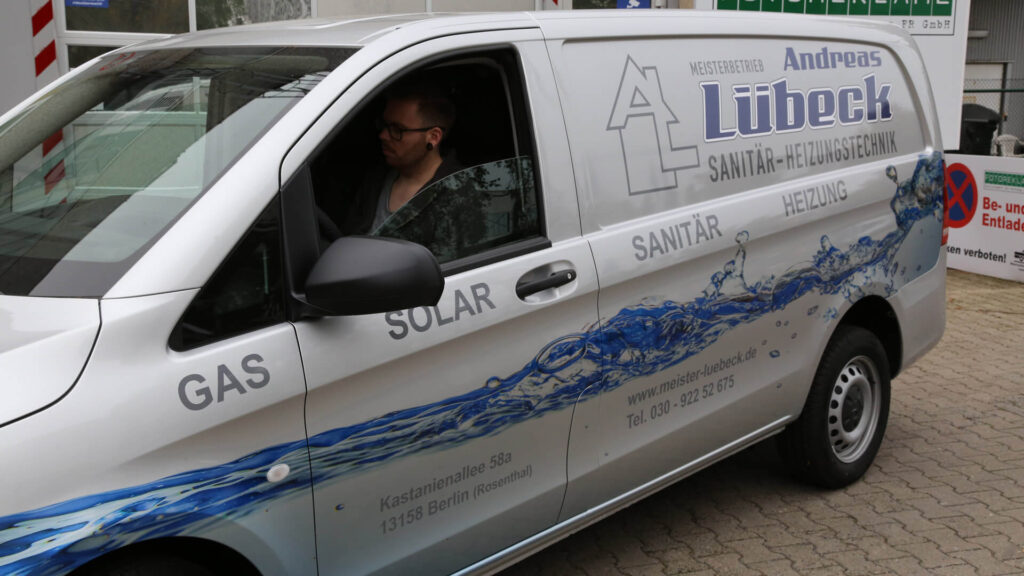
A company wants to apply graphics—consisting of a two-color logo, its name, and a phone number—to white vans. No photographs or color gradients are involved. Plot-cut vinyl is an obvious choice here, provided the appropriate colors are available and the details can be cut cleanly. The phone number is placed separately on the vehicle body; should it change, that specific area can be modified without affecting the rest. A full vehicle wrap is generally not required for this type of project.
A delivery service wants to display a product image.
A delivery service is planning large-scale product imagery for the sides of its vehicles, making digital printing an ideal choice. If the vehicle's paint color complements the design, the image can be applied as a partial wrap. The company name and contact details are positioned to ensure readability even from a distance. To accommodate frequently changing offers, a dedicated area is reserved for promotional messages; this allows the permanent product imagery to remain in place while the time-sensitive information is updated.
A service fleet regularly receives new vehicles.
A company uses multiple vehicle models and continuously expands its fleet. The design concept should therefore define appropriate placement and sizing for each model, while maintaining a consistent balance between the logo, core message, and contact details. Uniform background areas—or, if necessary, more extensive vehicle wrapping—help accommodate varying paint colors. Local phone numbers are handled separately. Approved production files and material specifications simplify the branding of additional vehicles, though the fit must be verified for each specific model.
Compare offers for total usage
The price of vehicle graphics involves more than just the surface area of the vinyl. The effort involved is also influenced by the preparation of print or cutting data, weeding, lamination (where applicable), vehicle preparation, and installation. Additional factors may include the removal of existing graphics and any subsequent adjustments.
Therefore, compare offers that include the same scope of services. Clarify which parts of the vehicles will be lettered, what materials are planned, and what preparatory work is included. For a commercial fleet, it is also important to consider how long the vehicles will be out of service for installation and whether the work can be scheduled in stages.
The intended duration of use should be specified at the inquiry stage. A short-term promotion imposes different requirements than a long-term brand presence. The underlying surface is also a crucial factor for eventual removal: repainted areas or existing paint damage can make the removal process difficult. Consequently, a blanket guarantee of residue-free and damage-free removal does not provide a reliable basis for planning.
This information helps with the concrete planning.
- Vehicle model, year of manufacture, body style, and current photos of all designated areas
- Number of vehicles and details regarding differing models or paint colors
- Logo preferably as a vector file, image material, and definitive color references.
- Desired message, vehicle sides to be covered, and planned duration of use
- Information to be modified later, as well as known existing film or paintwork damage.
- Budget framework, preferred installation date, and possible downtimes
This information can be used to check which combination of manufacturing process, surface area and material makes sense for your project. Photo advertising supports you in selecting and implementing yours Vehicle Signage.