When commissioning the printing of metal plates, one’s initial thoughts turn to the design, material, and print quality. However, for professional applications, this is often not enough. Especially with high-quality metal surfaces, outdoor use, or heavy-duty conditions, a crucial follow-up question arises: How can a printed metal plate be given additional protection? This is precisely where the topic of surface sealing for printed metal plates comes into play.
After all, a printed metal plate is not automatically a complete, ready-to-use solution. Depending on the project, an additional transparent surface coating may be advisable to enhance surface durability, further protect the printed image, and functionally optimize the overall assembly. This is not merely a matter of applying an arbitrary finish, but rather of creating a system structure that is technically and application-specifically tailored to requirements.
In a professional setting, this makes a crucial difference. It involves more than just printing; it requires a holistic approach where materials, existing surfaces, printing processes, stress factors, and protective coatings all work in harmony. Only then does a solution emerge that is not only visually impressive but also truly durable in actual use.
Why surface sealing is important for printed metal plates
Not every printed metal panel is subjected to the same stresses. An indoor panel intended primarily for aesthetic purposes places different demands on the material than an outdoor component exposed to UV radiation, moisture, temperature fluctuations, cleaning, or mechanical stress.
That is precisely why it is not enough to simply ask whether metal can be printed on. In many projects, the more important question is: Does the printed metal surface require additional protection?
This highlights the difference between simple printing and professional project work. Those who view metal surfaces merely as substrates for printing often focus solely on the design. In contrast, those who regard them as functional components automatically consider durability, surface protection, ease of maintenance, and long-term resilience.
Surface sealing is more than just a finish.
A surface sealer is neither a mere finishing coat nor a purely aesthetic addition. In a professional project context, it can be a functional component of the entire assembly.
This means that the additional protective layer is not simply added across the board, but is evaluated based on the specific project. Key factors include, among others:
- the material
- the existing surface condition
- the type of coating or finishing
- pressure build-up
- the subsequent stressing
- indoor or outdoor use
- the desired final visual effect
That is precisely why, when it comes to surface sealing for printed metal plates, we speak not merely of protection but of a system structure in which all layers work together effectively.
Types of surface protection available for printed metal plates
There is no single solution for protecting printed metal surfaces; different protection systems are suitable depending on the project. Two options are particularly relevant in this context: transparent powder coating and transparent liquid coating.
Transparent powder coating for surface protection
A transparent powder coating can be an attractive option wherever a robust, integrated protective system is required. Particularly with metal parts that are already powder-coated, it makes sense to consider this additional protection as part of the same system.
This can be particularly advantageous when a surface is intended for more demanding conditions. A weather-resistant powder coating is also available as a clear coat; transparent powder coatings are explicitly marketed as protection against UV radiation, weathering, and mechanical stress.
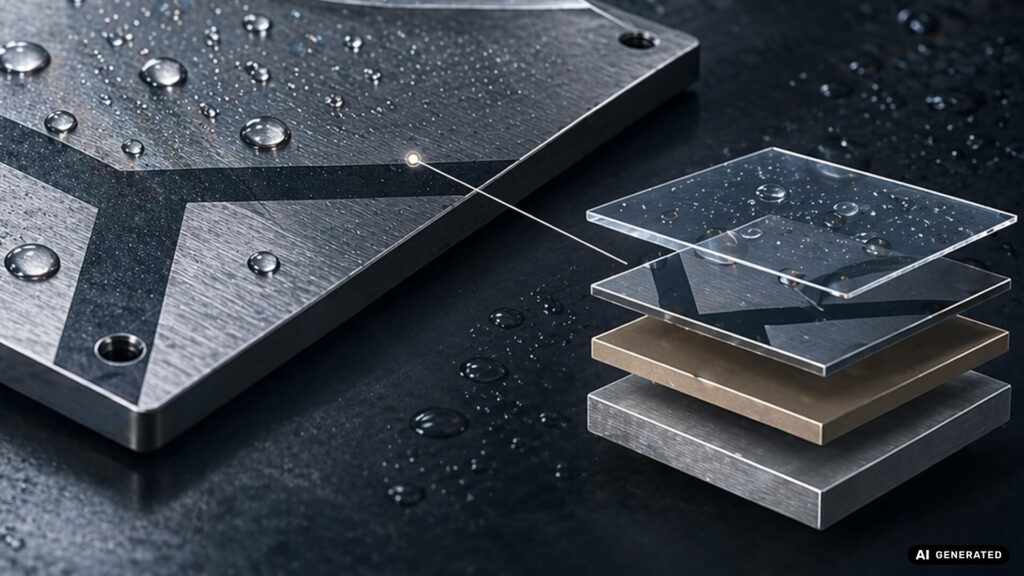
The advantage of such a design is that the transparent protective layer does not appear as a foreign element but instead integrates into the overall technical structure. This transforms a printed surface into a multi-layer system with a clear function.
Transparent coating for surface protection
In addition to a transparent powder coating, a transparent liquid coating can also serve as a suitable protective layer. This, too, serves to provide additional protection for the printed metal surface and to tailor the overall coating system to the intended application.
Transparent clear coats for metal are explicitly marketed with properties such as UV and weather resistance, scratch resistance, chemical resistance, and suitability for outdoor use.
A transparent coating is therefore not merely a cosmetic finish. It can be part of a functional solution when protective properties, material characteristics, and the area of application need to be effectively integrated.
Which surface sealant is appropriate depends on the project.
The most important sentence for this entire post is:
The choice of different surface sealants depends on technical as well as application-specific prerequisites and requirements.
That is precisely the professional crux of the matter. There is no single best solution for every metal plate; the decision must always be made based on the specific project.
Key factors include:
- the base material, for example aluminum, steel, or stainless steel
- the existing surface—for example, powder-coated, anodized, or otherwise finished
- pressure build-up
- the subsequent mechanical stress
- climatic stresses
- Indoor or outdoor use
- Cleaning requirements
- desired gloss level and final visual effect
This makes it clear: surface sealing is not a decision made out of habit, but a planning decision.
Practical example: printed, powder-coated sheet steel with an additional transparent protective layer.
The topic becomes particularly vivid where surface protection is approached not just theoretically, but practically. A compelling example is a construction consisting of powder-coated sheet steel, printing, and a subsequent additional transparent protective layer.
It is precisely projects like these that demonstrate that performance does not end with the printed image. Instead, a sophisticated layered structure is created in which the existing coating, the print, and the surface protection are harmonized. This makes the difference between a simple printed surface and a more durable technical solution.
It is important to note that even a construction of this type is not an absolute "forever solution." However, it can come significantly closer to a design that is robust, weather-resistant, and offers high-quality protection in the long term than unprotected direct printing.
When surface sealing for metal plates can be particularly beneficial

Applying an additional surface seal to printed metal plates can be particularly beneficial when there are stringent requirements. For example:
- for outdoor applications
- under greater mechanical stress
- for surfaces requiring regular cleaning
- if the print requires additional protection
- when a high-quality metal surface is to be functionally complemented
- if a more durable overall solution is sought
This topic is particularly relevant for outdoor applications. Both clear powder coatings and suitable clear metal coatings are explicitly marketed for scenarios involving exposure to weather, UV radiation, and mechanical stress.
Protective performance and aesthetics must go hand in hand.
A common mistake is to view surface sealing solely in terms of function. Of course, protection is a factor; however, particularly with printed metal panels, the surface itself is often part of the design.
In other words, a protective layer cannot be evaluated in isolation from the material's ultimate effect. It can influence the level of gloss, surface appearance, sense of depth, and overall aesthetic. That is precisely why it must not only perform technically but also visually complement the project.
This is particularly important for finished metal surfaces, powder-coated components, and high-quality visible surfaces, where the material itself already makes a strong statement.
Surface sealing begins with planning.
As with the printing of metal plates, the same applies here: good results are not achieved by chance, but through planning, testing, and technical clarity.
Before deciding on a protection solution, the following questions—among others—should therefore be clarified:
- What specific metal surface is present?
- What is the nature of the existing structure?
- What level of protection is actually required?
- What loads occur during actual operation?
- Is the application intended for indoors or outdoors?
- What visual effect should be preserved?
- Which sealant is the best fit, both technically and aesthetically?
Only once these points have been properly evaluated is it possible to make a sound decision as to whether a transparent powder coating, a transparent lacquer finish, or another type of protective coating is the right solution.
Not every sealant makes sense automatically.
This, too, is part of a professional approach: not every printed metal plate automatically requires an additional surface seal. Nor is every conceived protective solution ultimately technically, visually, or economically viable.
It is entirely possible that a planned setup may need to be adjusted, modified, or even discarded during the course of the review. Far from being a disadvantage, this actually reflects a serious approach to project work. After all, true professionalism lies not in making sweeping promises, but in developing viable solutions and identifying limitations at an early stage.
Conclusion: Surface sealing for printed metal plates is a matter of the system.
Surface sealing for printed metal plates is far more than just a final processing step. It is part of a broader system configuration and should always be considered in the context of the material, surface, printing, stress factors, and area of application.
Depending on the project, the additional protection can be applied, for example, as a transparent powder coating or a transparent lacquer finish. However, the appropriate solution always depends on the technical and application-specific conditions and requirements of the specific project.
Professionals who plan and process metal surfaces therefore think not only in terms of designs and formats, but also in terms of surface characteristics, loads, protective mechanisms, and functional interrelationships. That is precisely the difference between simple printing and a well-conceived, durable, high-quality solution.
FAQ: Frequently Asked Questions About Surface Sealing for Printed Metal Plates
What is a surface seal for printed metal plates?
A surface sealer is an additional protective layer tailored to an existing coating system, designed to make the printed metal surface more robust, durable, or easier to maintain.
What types of transparent surface protection are available?
Depending on the project, options for surface protection include, for example, transparent powder coatings or transparent lacquers.
Which solution is better: clear powder coating or clear lacquer?
There is no one-size-fits-all answer to this. The choice always depends on technical and application-specific prerequisites and requirements—such as the material, surface, pressure build-up, area of application, and desired final effect.
Is transparent clear coat for metal also suitable for outdoor use?
Suitable clear coats for metal are explicitly described as UV- and weather-resistant for exterior applications. However, whether this is the right solution for a specific project must still be evaluated based on the entire coating system.
Are transparent powder coatings also available as weather-resistant clear coats?
Yes. Manufacturers explicitly offer weather-resistant powder coatings in transparent clear-coat versions for both indoor and outdoor use.
Does every printed metal plate require an additional seal?
No. Additional sealing is not automatic. It only makes sense if it suits the specific project in terms of technical, visual, and functional aspects.