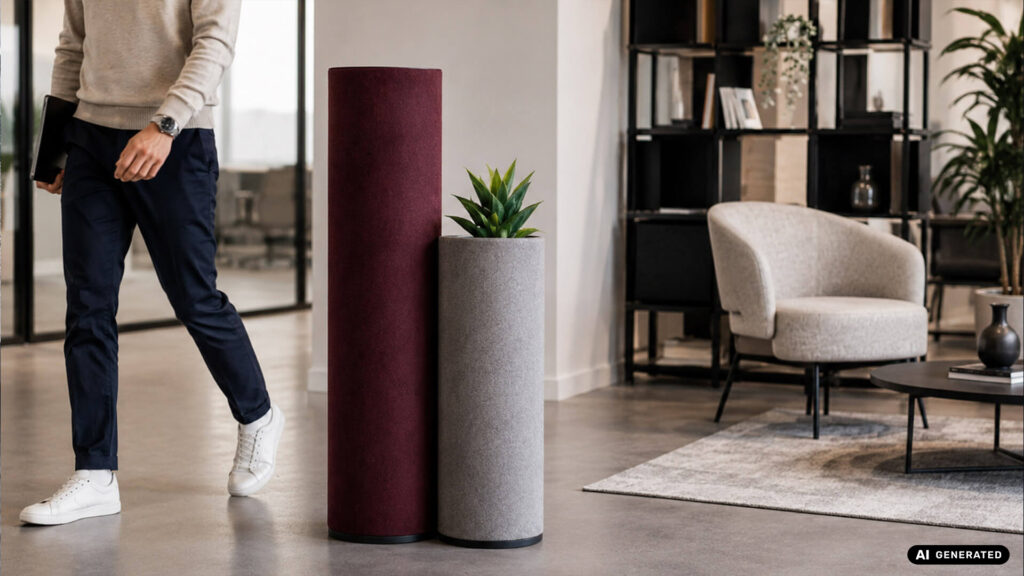
Acoustic columns offer an interesting solution for improving the acoustics of a room without requiring direct modifications to walls, ceilings, or permanent fixtures. Standing freely within the space, they can be positioned flexibly and combine sound insulation with aesthetic design. They are therefore a particularly valuable addition to offices, open-plan workspaces, meeting areas, and showrooms.
The major advantage is that acoustic columns do not come across as a purely technical measure. They can look decorative and visually structure a room while simultaneously helping to reduce reverberation. As a result, they improve not only the room's acoustics but also its atmosphere.
In this article, you will learn what acoustic columns are, how they work, where they can be effectively used, and what factors to consider regarding design, materials, and placement.
What are acoustic columns?
Acoustic columns are freestanding acoustic elements that absorb sound within a room, thereby improving room acoustics. They are often made of sound-absorbing materials such as felt or PET fiber panels. These materials have a more open, softer structure than hard surfaces and are better at absorbing sound.
Unlike wall or ceiling panels, acoustic columns are not permanently mounted to the wall or ceiling. They stand freely in the room and can be repositioned as needed. This makes them particularly practical for spaces where the usage changes or where permanent installation is not desired.
Acoustic columns come in various shapes. They can be round or angular, tall or short, and feature either understated or striking designs. Some versions resemble modern sculptures, while others look more like functional interior design elements. Combinations with additional features are also possible—such as an integrated planter at the top—creating an object that blends acoustics, decoration, and spatial design.
How do acoustic columns improve room acoustics?
In many office spaces, an unpleasant acoustic environment arises not just from the volume of noise itself, but from the way sound propagates through the room. Hard surfaces—such as glass, concrete, smooth walls, doors, tables, and floors—reflect sound. This increases reverberation, makes conversations seem louder, and creates a more restless atmosphere.
Acoustic columns address precisely this issue. Their surfaces are often made of materials capable of absorbing sound. This means that a portion of the sound is not simply reflected back into the room but is instead absorbed by the surface, thereby helping to reduce reverberation.
Simply put: sound does not linger in the room as long. As a result, conversations, phone calls, and everyday noises seem less harsh and less disruptive. This can help create a more pleasant working atmosphere, especially in open-plan offices.
Acoustic columns do not replace every other soundproofing measure. However, they offer a flexible way to improve room acoustics in specific areas while simultaneously adding design accents.
Where are acoustic columns used?
Acoustic columns are particularly suitable for interiors where sound needs to be reduced and spaces visually structured. They are most commonly used in offices.
- Open-plan offices
- open work areas
- Meeting areas
- reception areas
- Waiting areas
- showrooms
- Lounges
- Creative spaces
- Project zones
- Areas with changing use
In open-plan offices, acoustic columns can help make individual work areas more pleasant. They can be positioned between workstations, in conversation zones, or along walkways. In doing so, they serve not only acoustic purposes but also provide visual structure.
In meeting areas, they can help make conversations feel more pleasant and reduce room reverberation. In showrooms or reception areas, the decorative aspect also comes into play; a well-designed acoustic column can serve as a deliberate design element in such spaces.
However, in areas with high customer traffic, it should be noted that freestanding elements may be subject to greater wear and tear. As they stand in the open space, they can be touched, moved, or damaged. Therefore, the choice of material, positioning, and stability should be appropriate for the area's usage.
Benefits of acoustic columns in the office
Acoustic columns offer several advantages that are particularly relevant in an office setting.
Mobility is a key factor. Since acoustic columns stand freely in the room, they can be used without permanent installation. This is practical when ceilings or walls are not to be altered or when a room needs to remain flexible.
Another advantage is the combination of function and design. Acoustic columns not only improve acoustics but can also serve as decorative elements. They can break up the look of a room, add color accents, or enhance a specific atmosphere.
Retrofitting is also relatively straightforward. While sound-absorbing ceilings or permanently mounted wall panels have a greater impact on the room's design, acoustic columns can often be added later. This makes them an attractive option for existing office spaces where the aim is to improve acoustics without undertaking major renovations.
- can be positioned flexibly and is mobile
- no permanent wall or ceiling mounting required
- Improvement of room acoustics
- Reduction of reverberation
- decorative effect
- Can be designed with colors, patterns, or prints.
- suitable for open-plan office spaces
- can be retrofitted
- can be combined with other acoustic solutions
It is precisely this blend that makes acoustic columns so interesting. They are not merely a technical product, but a design element with an acoustic function.
Design possibilities: Acoustics don't have to look boring.
Acoustic columns do not have to be neutral or inconspicuous. They can be deliberately used as part of the interior design. Depending on their shape, color, material, and surface finish, they can blend subtly into the room or serve as an eye-catching feature.
Materials such as felt or PET fiber panels are particularly popular. They have a warm, textile-like feel and blend well with modern office and interior design concepts. At the same time, they enhance acoustic performance.
Printing is also an option, though it is important to remain realistic: the surface of felt or PET fiberboard is not as smooth as a standard printing plate or a film surface. Consequently, prints on these materials often appear somewhat softer and less razor-sharp. This can work very well for patterns, color gradients, graphic elements, or atmospheric motifs, whereas a smooth surface is usually better suited for extremely fine details or very small text.
In addition to the printed design, acoustic columns can also be combined with other elements. Depending on the concept, options include cutouts, plant inserts, decorative shapes, or additional design elements, allowing them to be even more effectively integrated into the spatial design.
- Solid-colored acoustic columns matching the room concept
- Patterns or graphic structures
- subtle corporate design colors
- printed surfaces
- Combination with plants
- round or angular shapes
- Columns as spatial objects or eye-catchers
- several columns as a design group
In this way, an acoustic measure becomes a visible part of the office design.
Where should acoustic columns be strategically placed?
Acoustic columns should not simply be placed anywhere in the room. To be effective, their positioning should suit the way the room is used.
They are particularly useful in areas where noise is generated or where sound makes a space feel restless—such as workspaces, conversation zones, meeting hubs, or waiting areas. Acoustic columns can also be effective between different functional zones, as they provide both acoustic and visual separation.
In open-plan offices, for example, they can be positioned between workstations or alongside walkways. In meeting areas, they can be placed close to the zones where conversations take place. In reception or showroom areas, they can serve a more decorative purpose while simultaneously improving the room's acoustics.
It is important that they do not get in the way. Their placement must be chosen carefully, especially in areas with customer traffic, escape routes, or high levels of movement. An acoustic column is intended to improve the space, not disrupt it.
In short: Placement should always depend on where the room is acoustically problematic and how the space is used in everyday life.
Acoustic columns compared to other acoustic solutions
Acoustic columns are just one of several ways to improve office acoustics. Depending on the room, wall panels, ceiling panels, acoustic rafts, room dividers, or sound-absorbing ceilings may also be suitable options.
Acoustic columns are particularly flexible because they are freestanding and can be installed retrospectively. They are well-suited for situations where acoustics and décor are to be combined.
Wall panels utilize available wall space and are often a good solution for meeting rooms, corridors, or offices with significant reverberation.
Ceiling panels and acoustic rafts work from above and are particularly attractive when large ceiling areas are available or walls are to be kept clear.
Room dividers also help to further zone open-plan areas and separate work areas from one another.
Sound-absorbing ceilings offer a comprehensive, surface-based solution for permanently improving room acoustics.
Acoustic columns are therefore particularly suitable when a flexible, visible, and decorative solution is required. For larger or particularly demanding spaces, combining them with other measures may be advisable.
What should be considered during planning and implementation?
Acoustic columns are not just about placing an attractive object in a room; they should suit the room's size, usage, design, and acoustic conditions.
- Where is the most sound generated in the room?
- Is there any disturbing reverberation?
- Should the column remain mobile?
- Is the area heavily frequented?
- Is there an increased risk of damage?
- Should the column have a more understated or a striking appearance?
- Is printing or a pattern desired?
- Do the shape and color fit the existing room concept?
- Is there enough space for free-standing elements?
- Should the acoustic column be combined with plants or other elements?
Practicality for everyday use should be taken into account, especially in areas with high foot traffic. A decorative column may look attractive, but it must also suit the way the space is used. If many people walk past it, children are nearby, or objects are frequently moved, its placement should be chosen accordingly.
Maintenance is also a factor. Textile and fiber-based surfaces have a pleasant feel but can be more susceptible to soiling or mechanical stress than smooth, hard surfaces. Therefore, it is important to determine beforehand how much wear and tear the column will be subjected to in everyday use.
Conclusion: Acoustic columns combine improved room acoustics with design.
Acoustic columns are a practical and attractive solution for improving room acoustics in the office. They can reduce reverberation and make spaces more pleasant while simultaneously serving as a decorative element. They offer an excellent way to combine sound insulation with interior design, particularly in open-plan offices, open work areas, meeting zones, and showrooms.
Their major advantage lies in their flexibility. Acoustic columns are portable and can be installed retrospectively; depending on the room concept, they can be designed to be understated or eye-catching, round or angular, printed, or equipped with additional functions.
It is important not to view the columns in isolation. Their impact depends on the size of the room, the materials used, their placement, their function, and the overall design. However, when properly planned, they can be far more than just an acoustic aid: they become a visible element of the interior design and contribute to a more pleasant atmosphere.
FAQ: Frequently Asked Questions About Acoustic Columns
What are acoustic columns?
Acoustic columns are freestanding acoustic elements that absorb sound within a room, thereby improving room acoustics. They are often made of felt, PET fiberboard, or similar sound-absorbing materials.
Where are acoustic columns used?
Acoustic columns are primarily used in offices, open-plan offices, meeting areas, reception zones, showrooms, and open workspaces. They are particularly well-suited for spaces where acoustics and design are to be combined.
Are acoustic columns portable?
Acoustic columns can be custom-manufactured to be mobile and freely positionable within a room. This makes them particularly attractive for existing office spaces or rooms with changing uses.
Do acoustic columns help with office noise?
Acoustic columns can help reduce reverberation and make the room acoustics more pleasant. They absorb some of the sound, thereby ensuring that noises seem less harsh and less disruptive.
Can acoustic columns be printed?
Yes, acoustic columns can be printed or designed, depending on the material. However, with felt or PET fiber panels, the print image is not as crisp and sharp as it is on smooth surfaces. Nevertheless, such surfaces are well-suited for patterns, colors, and graphic designs.
Are there round and square acoustic columns?
Yes, acoustic columns can be implemented in round, square, or other shapes.
Can acoustic columns also be used for decorative purposes?
Yes, that is precisely one of their major advantages. Acoustic columns can not only improve room acoustics but also serve as decorative objects. Some versions can even be combined with plant inserts or other design elements.
Are acoustic columns better than wall panels?
Not necessarily. Acoustic columns are more flexible and portable, whereas wall panels utilize available wall space and are permanently mounted. Which solution is better suited depends on the room and the desired outcome.
What should you look for in acoustic columns?
Material, stability, positioning, design, and the use of the space are important factors. In areas with high customer traffic, it should also be considered that free-standing elements are more likely to be touched or damaged.
For which rooms are acoustic columns particularly suitable?
Acoustic columns are particularly well-suited for open-plan offices, large office spaces, meeting areas, showrooms, and reception zones. They are ideal when a flexible acoustic solution with a decorative touch is required.
Disclaimer: Cover image created with AI.