An office can be designed to be modern, open, and high-quality—yet still feel draining in day-to-day use. Conversations echo through the space, phone calls overlap, focused work becomes difficult, and even brief consultations turn into a constant acoustic strain. This is precisely where office soundproofing comes into play.
It is not simply a matter of making rooms “quieter.” What matters is how sound is generated, reflected, distributed, and perceived within a space. Good room acoustics make conversations easier to understand, work areas more pleasant, and office spaces more functional. Targeted acoustic design can significantly improve the workday, particularly in open-plan offices, meeting rooms, reception areas, call centers, law firms, medical practices, and agencies.
This article provides an overview of the key options for office soundproofing. It serves as a central guide and highlights specialized solutions such as acoustic columns, wall panels, ceiling panels, room dividers, textile wall surfaces, and sound-absorbing ceilings.
Why soundproofing is so important in the office
Noise is part of everyday office life. Sounds from keyboards, conversations, printers, phone calls, footsteps, doors, coffee machines, and spontaneous discussions cannot be completely avoided. Problems arise when these sounds travel unchecked through the room or reflect off hard surfaces.
- hard soils
- large glass surfaces
- smooth walls
- exposed ceiling structures
- few textile or absorbent surfaces
- large, contiguous floor areas
- many people in a room
- lack of acoustic zoning
Reverberation quickly develops in such environments. This means that sounds do not vanish immediately but linger in the room for a brief moment. The stronger this effect, the louder, more restless, and more exhausting the environment feels.
Office soundproofing therefore pursues several goals simultaneously: reducing noise, minimizing reverberation, controlling the distribution of speech, and improving the acoustic separation between individual work areas.
Sound protection, sound insulation, and room acoustics: What is the difference?
In everyday life, terms such as sound protection, sound insulation, and room acoustics are often used interchangeably. However, distinguishing between them is helpful for planning purposes.
Sound protection is the general umbrella term. It describes measures intended to reduce or block noise, or to make it more pleasant. In an office setting, this can involve both structural measures and retrofitted acoustic solutions.
Sound insulation primarily refers to reducing sound transmission between two areas. For example, a meeting room might need to be less audible from the outside, or noise from a hallway should be prevented from entering an office. Walls, doors, ceiling connections, and structural details play a major role in this regard.
Room acoustics, on the other hand, describe how sound behaves within a space. In other words: How much does the room echo? How intelligible is speech? How loud does a space seem during normal use? This is a particularly relevant area for many offices, as room acoustics can be improved retrospectively through the use of targeted elements.
For many projects, the focus is therefore less on complete sound insulation and more on a noticeable improvement in room acoustics. This is particularly important when existing office spaces are to be optimized without directly altering the building structure.
Which surfaces influence the acoustics in the office?
Sound propagates through a room and strikes various surfaces. Hard, smooth surfaces reflect sound particularly strongly. In contrast, soft, porous, or specially structured materials can absorb sound, thereby reducing reverberation.
- Walls
- Cover
- Glass surfaces
- Floor areas
- Furniture
- textile surfaces
- open spatial zones
- Partition surfaces between work areas
Depending on the room, different surfaces may be the decisive factor. In a small meeting room, wall surfaces can have the greatest impact. In an open-plan office, ceiling solutions, room dividers, and acoustic columns may be more practical. In prestigious areas, it is also important that the soundproofing solution complements the room's design.
That is why there is no single perfect solution for every room. Effective soundproofing in the office is achieved through a combination of understanding the space, selecting the right materials, design, and professional implementation.
Acoustic columns: sound insulation, interior design and function in one
Acoustic columns are freestanding elements used to improve room acoustics. They can absorb sound, visually divide spaces, and simultaneously serve as a design feature. A particular advantage is that they do not necessarily need to be mounted on walls or ceilings.
This makes acoustic columns an attractive option for open-plan offices, reception areas, waiting zones, coworking spaces, or any setting where flexible solutions are required. They can be positioned freely within a space, helping to structure acoustically busy areas more effectively.
Another advantage is that acoustic columns can be visually adapted to the office environment. Depending on the material and finish, they can be designed to be neutral, decorative, or aligned with the brand. Printed surfaces are also an option if the columns are intended to contribute to corporate communication visually, in addition to serving a functional purpose.
Acoustic columns are particularly suitable when sound insulation and interior design are to be considered together. They not only improve acoustics but can also help make large spaces feel more pleasant and structured.
More about this in the specialized guide: Acoustic columns: sound insulation, interior design and function in one
Wall panels: Sound insulation for walls with a visible design effect
Wall panels are among the classic solutions for improving room acoustics. Mounted directly onto the wall, they reduce sound reflections. Acoustic wall panels can make a clearly noticeable difference, especially in rooms with many hard surfaces.
- Meeting rooms
- Private offices
- Conference rooms
- Reception areas
- Hallways
- Waiting areas
- open-plan office areas with long wall surfaces
The great advantage of wall panels lies in the combination of function and design. They can be used as a calm, understated surface or serve intentionally as a design element. Depending on the specific design, options include various shapes, colors, patterns, textile surfaces, or printed motifs.
This is particularly interesting for companies because acoustic surfaces need not appear out of place. They can be integrated into the spatial concept while simultaneously reinforcing the corporate design. In this way, a technical measure becomes a visible element of the office design.
Wall panels are particularly useful when there is available wall space and the aim is to specifically improve room acoustics without altering ceiling or floor areas.
Find out more in the specialized guide: Wall panels – sound insulation for walls with a visible design impact.
Ceiling panels & acoustic rafts: Targeted reduction of overhead sound
In many offices, the ceiling is a particularly effective surface for acoustic treatments. This is because ceiling areas are large, and sound within a room often travels upwards before reflecting back into the workspace. Ceiling panels and acoustic rafts can address precisely this issue.
Acoustic sails are frequently suspended from the ceiling. They absorb sound, thereby reducing reverberation within the room. At the same time, they offer design flexibility: they can be installed individually or in groups, arranged in straight lines or staggered patterns, or used as a deliberate design element.
- Open-plan offices
- Meeting rooms
- Creative spaces
- Reception areas
- Common rooms
- Training rooms
- Offices with exposed concrete ceilings or open ceiling structures
A key advantage is that the walls remain unobstructed. This is particularly practical when wall space is already taken up by shelving, glass surfaces, monitors, whiteboards, or decorative elements. Ceiling-based solutions can also be a good alternative in rooms where the wall design is to remain unchanged.
Acoustic sails can also contribute to visual zoning. Positioned above meeting tables, work islands, or waiting areas, they create not only better acoustics but also a clearer spatial structure.
Find out more in the specialized guide: Ceiling Panels & Acoustic Sails – Targeted Reduction of Overhead Sound
Room Dividers: Flexible Soundproofing Solutions for Open-Plan Offices
,
Open-plan office spaces are intended to foster communication, yet they can quickly become acoustically restless. Conversations spread, work areas blend into one another, and individual teams disturb each other. Acoustic room dividers can help structure such spaces more effectively.
Room dividers serve not only as visual screens but can also contribute to sound absorption. They interrupt direct sound paths, create distinct zones, and enhance the sense of privacy. This is a particularly important factor in open-plan office environments.
- Work islands
- Call areas
- Project zones
- Waiting areas
- Reception areas
- flexible meeting areas
- Coworking spaces
- temporary jobs
The advantage of room dividers lies in their flexibility. They can be mobile, free-standing, or permanently integrated. This allows office spaces to be adapted to changing requirements without the need for structural partition walls.
In terms of design, too, room dividers offer a wide range of possibilities. They can be kept neutral, color-coordinated, or custom-printed, allowing them to be integrated into the office not only functionally but also visually.
Acoustic room dividers are particularly useful when a room is used for multiple purposes simultaneously and these areas need to be better separated from one another.
Find out more in the specialized guide: Room Dividers: Flexible Soundproofing Solutions for Open-Plan Offices.
Wall Textiles: Soft Surfaces Counteracting Harsh Room Acoustics
Textile wall surfaces are an effective way to make harsh room acoustics more pleasant. While smooth walls strongly reflect sound, textile surfaces can absorb sound and give the room a softer feel.
Wall-mounted textiles are an excellent option when a large surface area needs to be designed. They can be implemented as wall coverings, printed fabric panels, decorative textile elements, or integrated acoustic solutions, thereby combining interior design, brand impact, and acoustic functionality.
- Conference rooms
- Lounges
- Reception areas
- Hallways
- Office space
- Work area backsplashes
- Waiting areas
- Display areas
A major advantage of textile solutions is their design versatility. Colors, patterns, motifs, and large-format prints can be used to visually enhance spaces. This is particularly appealing for companies that want to avoid an overly technical look for their acoustic treatments.
Wall-mounted textiles are therefore well-suited for spaces where atmosphere plays a key role. They can appear understated and minimalist, or be used deliberately to showcase a brand.
Find out more in the specialized guide: Textiles on Walls: Soft Surfaces vs. Harsh Room Acoustics.
Sound-absorbing ceilings: A comprehensive acoustic solution for permanently quieter offices
Sound-absorbing ceilings offer a particularly comprehensive solution for permanently improving room acoustics. Unlike individual panels or movable elements, they cover the entire ceiling area, thereby transforming the overall impression of the room.
Especially in high-traffic office areas, an acoustically effective ceiling can help lower the general noise level and reduce reverberation. It is particularly suitable for spaces where many people work or speak simultaneously.
- Open-plan offices
- Call center
- Meeting areas
- Training rooms
- Seating areas
- Reception and waiting areas
- public or semi-public indoor areas
Sound-insulating ceilings can be implemented in various ways depending on the room concept. Options include full-surface systems, individual ceiling panels, or solutions combined with other acoustic elements. It is important to carefully consider how the room will be used: a quiet meeting room has different requirements than an open-plan office with numerous workstations.
A sound-absorbing ceiling is particularly beneficial when a long-term, comprehensive improvement in room acoustics is desired. It can be combined with wall solutions, room dividers, or acoustic columns to create a cohesive overall concept.
Find out more in the specialized guide: Sound-absorbing ceilings: A comprehensive acoustic solution for permanently quieter offices.
Which soundproofing solution suits which office?
The right solution depends heavily on the specific problem at hand. Not every acoustic measure addresses every problem equally well. Therefore, the starting point should always be the question: What exactly is the issue?
If conversations are audible throughout the room, room dividers, acoustic columns, or zoning elements can be useful. If the room has significant reverberation, wall panels, ceiling panels, acoustic rafts, or textile wall surfaces are often effective. If a large area needs to be permanently quieted, a sound-absorbing ceiling may be the right solution.
A rough guide:
Wall panels, acoustic rafts, textile wall surfaces, or sound-absorbing ceilings are often suitable for meeting rooms. The aim is usually to improve speech intelligibility and reduce reverberation.
For open-plan offices, combinations of ceiling solutions, room dividers, acoustic columns, and wall panels make sense. The focus here is often on zoning, reducing reverberation, and creating a generally quieter working atmosphere.
Design and acoustics play an equally important role in reception areas and waiting zones. Textile wall surfaces, wall panels, or acoustic columns can lend the space a more high-quality and pleasant feel.
Mobile room dividers and free-standing acoustic elements are attractive options for flexible workspaces because they can be adapted to changing usage scenarios.
Custom-designed or printed solutions are ideal for representative spaces. This allows office soundproofing to be implemented in a way that is not only functional but also visually harmonious.
Office soundproofing doesn't have to look technical.
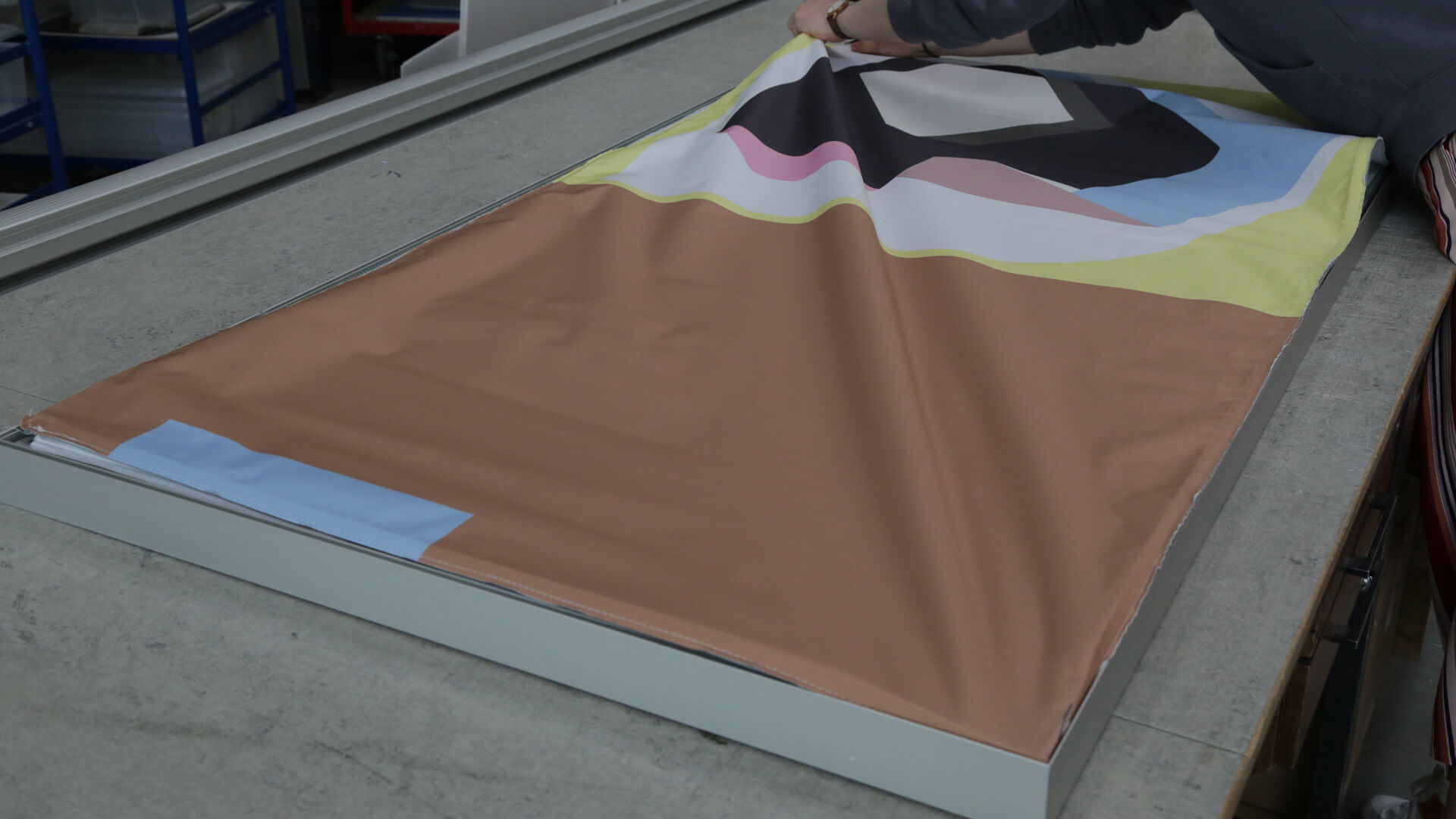
When thinking of soundproofing, many people first picture purely functional elements. In modern offices, however, this need not be the case. Acoustic solutions can be designed to be visible, color-coordinated, or integrated with motifs, patterns, and branding elements.
This is particularly interesting when offices are intended not only to function effectively but also to convey a sense of identity. Acoustic solutions can be integrated discreetly into the spatial concept or deliberately employed as design elements. Options include, for example, printed fabric surfaces, custom-designed wall panels, colorful acoustic elements, or room dividers that incorporate corporate design motifs.
This creates a dual benefit: room acoustics improve, and the office is simultaneously enhanced in terms of design.
Planning and implementation: What matters?
For office soundproofing to be effective, the solution should suit the room, its intended use, and its design. A decision based solely on aesthetics is often insufficient. Key factors include where the sound originates, which surfaces reflect it, and how people use the space on a daily basis.
- Which areas are particularly noisy?
- Is there any disturbing reverberation?
- Are conversations carrying too far across the room?
- Should the solution be permanently installed or flexible?
- What spaces are available?
- Should the solution be designed to be visible, or integrated as discreetly as possible?
- Do branding, colors, or motifs need to be taken into account?
- Is wall or ceiling mounting possible?
- Are there requirements regarding cleaning, fire safety, or material durability?
The more clearly these points are answered, the better a suitable solution can be developed.
Fotoreklame supports the implementation of such projects by providing consultation, site measurements, custom design, production, printing, and installation. This ensures that acoustic solutions are not only planned for functionality but also executed in a way that visually complements the specific space.
Conclusion: Soundproofing in the office improves more than just noise levels.
Soundproofing in the office is an important aspect of modern workplace design. A good acoustic environment can boost concentration, make conversations more pleasant, and give spaces an overall higher-quality feel.
There is no single right solution for every office. Wall panels, ceiling panels, acoustic rafts, room dividers, textile wall surfaces, sound-absorbing ceilings, and acoustic columns each have their own strengths. The best result is often achieved through a combination of several measures.
It is important to view the space not only from a technical perspective but also from a design standpoint. Soundproofing can be functional without appearing dull; it can blend in subtly or become an intentional part of the room's design.
Anyone looking to improve office acoustics should therefore not start with individual products, but rather with the room itself: How is it used? Where does noise originate? What surfaces are available? And what kind of atmosphere should the room ultimately create?
On this basis, a solution can be developed that is acoustically sound, aesthetically appropriate, and practically feasible.
FAQ: Frequently Asked Questions About Office Soundproofing
What are the benefits of soundproofing in the office?
Office soundproofing helps reduce distracting noise and reverberation while making room acoustics more pleasant. As a result, conversations become clearer, work areas feel quieter, and focused work becomes easier.
What is the difference between sound insulation and room acoustics?
Sound insulation is the general term for measures taken against unwanted sound. Room acoustics describes how sound behaves within a room. In offices, the aim is often to improve room acoustics—that is, to reduce reverberation and disruptive sound reflections.
Which soundproofing measures are suitable for open-plan offices?
Acoustic sails, ceiling panels, room dividers, acoustic columns, and wall panels are particularly suitable for open-plan offices. A combination is often advisable, as open office spaces present multiple acoustic challenges simultaneously.
Do wall panels help with office noise?
Wall panels can significantly improve room acoustics by reducing sound reflections off walls. They are particularly effective at mitigating reverberation and making rooms acoustically more pleasant. However, on their own, they are usually insufficient for complete sound insulation between rooms.
When do acoustic sails make sense?
Acoustic sails are a practical solution when the ceiling can be utilized as a large, unobstructed surface. They are particularly well-suited for offices, meeting rooms, and open-plan work areas where the aim is to reduce reverberation without occupying wall space.
What are the acoustic benefits of room dividers?
Acoustic room dividers can structure open-plan office spaces, interrupt direct sound paths, and make individual work areas more pleasant. They are particularly practical when flexible or retrofitted solutions are required.
Can sound insulation solutions be printed?
Yes, many acoustic solutions can be custom-designed or printed. These include, for example, textile wall surfaces, room dividers, wall panels, or specific acoustic elements. This allows sound insulation to be combined with corporate branding.
Which solution is the best for my office?
It depends on the room, its use, and the specific problem. Wall or ceiling solutions can be effective for addressing reverberation. Room dividers or acoustic columns often help in open-plan work areas. An acoustic ceiling may be a suitable choice for a lasting, comprehensive improvement.
Does office soundproofing have to be permanently installed?
Not always. There are fixed solutions such as wall panels, ceiling panels, or sound-absorbing ceilings, as well as flexible elements like room dividers or acoustic columns. Which option is suitable depends on whether the room is intended for permanent or flexible use.
Can soundproofing also be implemented retroactively?
Yes, many soundproofing solutions can be retrofitted in existing offices. Wall panels, acoustic rafts, room dividers, textile wall surfaces, and acoustic columns, in particular, can often be added without major structural alterations.