When hard-surfaced rooms sound unpleasant
Modern offices, medical practices, and reception areas often have a bright, open, and minimalist aesthetic. Glass surfaces, smooth walls, hard flooring, large windows, and minimalist furniture create a clean look. However, these very surfaces can pose acoustic challenges: voices echo, phone calls seem louder, conversations overlap, and the room quickly feels more restless than it needs to be.
Wall-mounted textiles address precisely this aspect. They introduce soft surfaces into rooms otherwise defined by hard materials. Consequently, they can help reduce sound reflections, improve speech intelligibility, and create a generally calmer atmosphere. At the same time, textile wall surfaces offer a significant design advantage: they can be printed, color-matched, layered, or used as a subtle design element.
It is important to view this in the right context: textile wall solutions do not replace structural sound insulation. Consequently, they do not reliably prevent sound from being transmitted from one room to another. However, they can improve the acoustics within a room by softening hard surfaces and reducing reverberation.
Why textiles on walls can make sense acoustically
In a room, sound strikes various surfaces. Hard, smooth surfaces reflect a large portion of the sound back into the room, creating reverberation. The more hard surfaces there are, the more pronounced this effect becomes. This can quickly become bothersome, particularly in offices, meeting rooms, waiting areas, or treatment rooms.
Textile materials behave differently. Depending on their construction, material thickness, and substructure, they can absorb sound, scatter it, or transmit it to underlying absorbent layers. Textile wall solutions are particularly effective when they are not merely applied for decorative purposes but are combined with an acoustically sound structure. Examples include fabric in a tension frame, an acoustic art panel, a felt surface, or a textile finish on an absorbent backing board.
It is important to note that not every fabric is automatically effective from an acoustic standpoint. A very dense, coated, or air-impermeable fabric is more likely to reflect sound than to allow it to pass through. Materials of interest for acoustic applications are those that either possess inherent sound-absorbing properties or can transmit sound to an acoustic layer positioned behind them. Therefore, the choice of material should be based not only on aesthetics but also on the room, its intended use, and the desired acoustic effect.
Design and acoustics need not be mutually exclusive.
The great advantage of wall textiles lies in the combination of function and design. An acoustic treatment does not have to look like a technical solution; textile wall surfaces can be deliberately planned as part of the interior design concept.
In offices, for instance, corporate design colors, areas of solid, calming color, abstract patterns, or large-scale motifs can be employed. Textile wall art can lend a meeting room a more high-end, focused feel, while a reception area can be made to look warmer and more inviting. In waiting or treatment rooms, soft colors, nature motifs, or subtle textures can help create a calmer atmosphere.
Atmosphere plays a crucial role, particularly in spaces where people sit for extended periods, wait, receive consultations, or need to work with deep concentration. Harsh room acoustics often go unnoticed at first; people simply sense that the space feels draining. Textile wall surfaces offer a twofold benefit here: they enhance the room's visual softness while simultaneously reducing acoustic strain.
Brand impact can also be effectively integrated. Instead of treating a wall purely for function, it can be utilized as a design element. This results in solutions that do not look like an acoustic retrofit, but rather like an intentionally planned component of the interior design.
Possible solutions for textile wall surfaces
There are various ways to implement wall-mounted textiles. The right solution depends on the size of the room, the wall area, the desired aesthetic, the intensity of use, and the acoustic objectives.
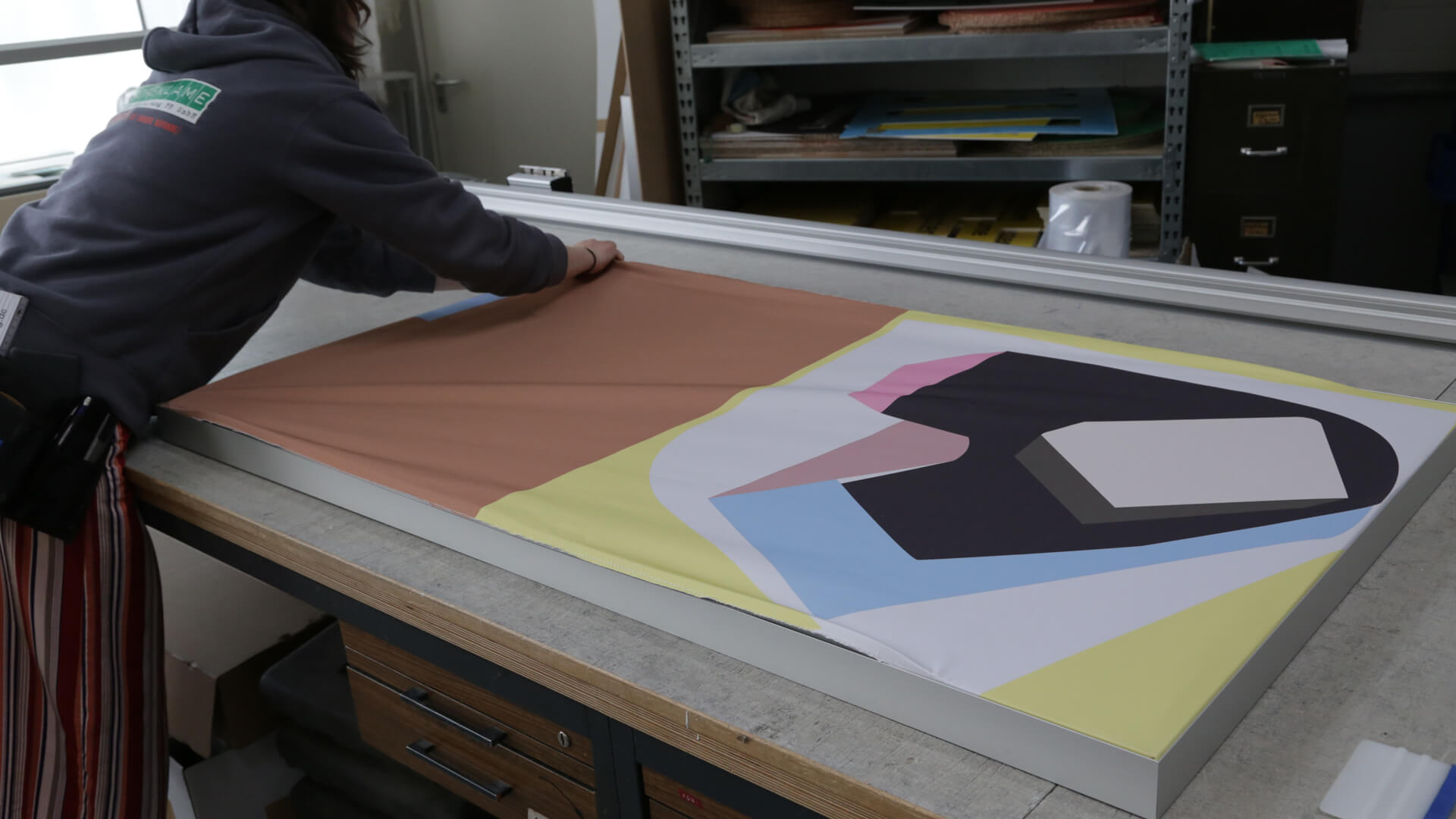
One common option involves printed fabrics mounted in tension frames. In this setup, a printed textile graphic is stretched within a frame and mounted on the wall. This solution is particularly well-suited for high-quality wall art, large-format imagery, or modular design systems. Its advantages lie in the clean aesthetic and the ability to customize the design, color, and size to suit the specific space.
Acoustic art panels work in a similar way but generally feature a design specifically optimized for acoustics. They combine a decorative image with an absorbent layer, making them well-suited for meeting rooms, offices, waiting areas, or reception zones where visual appeal is desired.
Wall-mounted felt is another interesting solution. Felt creates a sense of warmth and tranquility while offering an architectural aesthetic. It can be applied as a continuous surface, in strips, as individual panels, or as a multi-layered composition. Felt becomes particularly compelling when designed not merely as a flat surface, but as a graphic or relief-like element.
PET fiber panels with a textile or felt-like appearance are another option. Depending on the specific product, they can offer a modern, minimalist surface and be used in a variety of shapes, colors, and cut sizes. Such solutions are attractive for offices and commercial spaces where a clean design aesthetic needs to be combined with acoustic functionality.
Fabric banners, stretched fabric panels, or textile elements that are not directly mounted as wall coverings can also play a role. They are particularly suitable for applications requiring a flexible, lightweight, or large-scale design. Here, too, it is important that the construction aligns with the acoustic objective; a purely decorative fabric surface does not automatically provide the same effect as a technically engineered acoustic element.
Where textiles on walls make particular sense
Textile wall solutions are particularly suitable for spaces dominated by hard surfaces where people regularly talk, work, wait, or receive consultations. These include offices, open-plan offices, meeting rooms, conference rooms, reception areas, and corridors.
Wall-mounted textiles can also be a sensible choice for medical or therapeutic facilities. Waiting areas, treatment rooms, consultation rooms, and corridors often benefit from a calmer, more pleasant atmosphere. Especially in settings where people are sensitive to their surroundings or where confidential conversations take place, pleasant acoustics play a key role in the overall experience of the space.
Textile wall surfaces can also be used in law firms, agencies, educational institutions, showrooms, hotels, or public waiting areas. The decisive question is always: What wall surfaces are available, which surfaces cause reflections, and what design suits the room's intended use?
Not every wall requires full-surface treatment; often, it is sufficient to focus on specific areas. Textile elements are particularly effective on large, open wall spaces, opposite glass surfaces, in conversation zones, or in areas where voices are strongly reflected.
Points to consider during planning
When it comes to wall textiles, the design should not be the only focus. The interplay between the space, material, structure, and installation is crucial. Several questions should be clarified before implementation:
Which wall area is to be designed? Is there any distracting reverberation? Should the solution have a subtle or a striking effect? Is a specific motif, color, pattern, or textile texture desired? Does the surface need to be particularly robust? Are there requirements regarding fire safety, cleaning, or use in public areas?
Print quality also plays a role. Intricate designs, corporate colors, or large areas of solid color place different demands on materials and production. A design that looks good on paper or film will not necessarily look identical on a textile material. Fabrics have a unique texture that can influence the printed image.
In addition, the mounting method should suit the surface. Frame systems, panel solutions, or textile elements must be installed securely, straight, and durably. A neat finish is particularly important in commercial spaces to ensure the solution appears not only functional but also high-quality.
Conclusion: Textiles on walls noticeably and visibly improve rooms.
Wall-mounted textiles are an effective way to soften harsh room acoustics and make spaces more pleasant. They can reduce reverberation, make conversations more comfortable, and significantly enhance the visual appeal of a room.
The most important point is to have the right expectations: textile wall surfaces do not provide structural sound insulation. They do not reliably prevent sound from being transmitted from one room to another. However, they can improve the acoustics within a room and make hard surfaces appear softer—both acoustically and visually.
Textile wall solutions are particularly interesting for offices, meeting rooms, reception areas, waiting rooms, treatment rooms, and other spaces where people need to concentrate, interact, or feel at ease. Through the use of print, color, material, and construction, functional acoustic measures can be combined with high-quality wall design.
If you are planning textile wall coverings for your office, practice, or commercial premises, Fotoreklame supports you every step of the way—from consultation, site measurements, design, printing, and production through to installation.
FAQ: Wall Textiles and Room Acoustics
Do wall textiles really improve acoustics?
Yes, textile wall solutions can improve room acoustics if the material and construction are chosen appropriately. They can reduce sound reflections and thereby decrease reverberation in the room. However, their effectiveness depends heavily on surface area, material, room size, and construction.
Are wall textiles the same as soundproofing?
No. Wall textiles primarily improve the acoustics within a room. Structural sound insulation, on the other hand, deals with the transmission of sound between rooms or from the outside in. Textile wall surfaces do not replace structural sound insulation.
What textile wall solutions are available?
Options include, for example, printed fabrics in tension frames, acoustic art panels, felt surfaces, PET fiber boards with a textile look, textile panels, fabric banners, or multi-layered textile designs. The right solution depends on the room and the desired outcome.
Are wall textiles suitable for offices?
Yes, textile wall surfaces can be a sensible choice, particularly in offices, open-plan offices, meeting rooms, and reception areas. They can balance out hard surfaces while simultaneously serving as a design element.
Are textile wall surfaces also suitable for waiting rooms or treatment rooms?
Yes, waiting rooms, treatment rooms, and consultation areas in particular often benefit from a pleasant atmosphere. Textile wall surfaces can give rooms a visually softer appearance and—depending on the construction—also improve the acoustic environment.
Can wall textiles be custom-printed?
Yes, many textile solutions can be custom-printed. Options include, for example, pictorial motifs, abstract patterns, solid color areas, graphic elements, or corporate designs. The chosen motif should always complement the material and the overall effect on the room.
Which is better: an acoustic print, felt, or fabric in a frame?
It depends on the objective. An acoustic image is a good choice if you want to combine imagery with functionality. Felt creates an architectural, serene look. Fabric in a tension frame offers great design flexibility for large-format prints. The best solution is determined by the room, its intended use, design preferences, and acoustic requirements.
Does an entire wall need to be designed using textiles?
No, strategically placed textile surfaces are often sufficient. Large, unobstructed wall areas, surfaces facing glass, or areas where conversations take place are particularly suitable. Covering the entire surface is possible but not always necessary.